
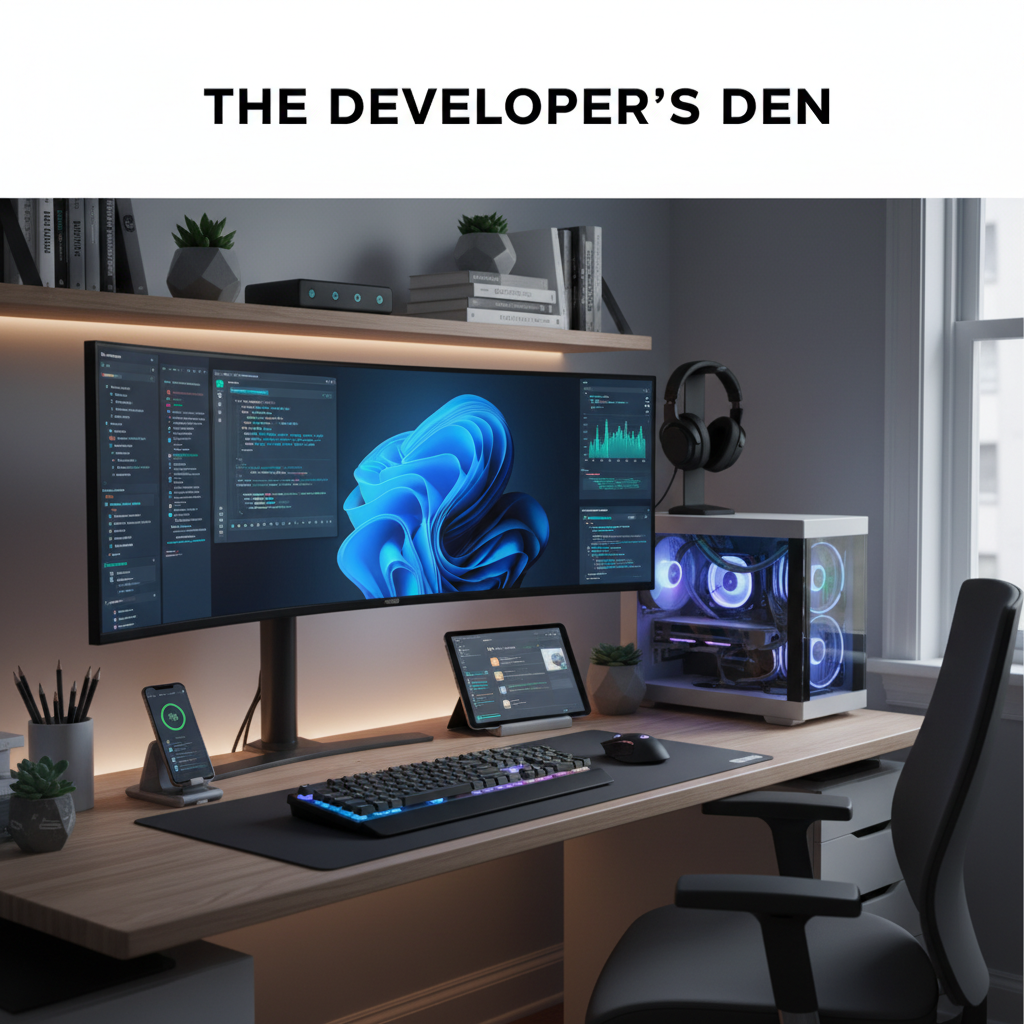
The Developer’s Den: Optimizing Your Home Workspace for Maximum Productivity and Tech Integration
For many of us in the software development world, the “office” is no longer a cubicle in a glass skyscraper; it is a corner of our living room, a spare bedroom, or a finished basement. Creating a space that fosters deep work and handles our heavy tech loads requires more than just a desk and a laptop. If you are looking to truly transform your living space into a high-performance studio, collaborating with a professional home renovation company oakville can turn your vision into a reality. A well-designed workspace is an investment in your career, reducing physical strain and mental fatigue while providing the perfect environment for those late-night debugging sessions.
Building the ultimate “Developer’s Den” is about more than just buying the most expensive gear. It is about the synergy between your physical environment and your digital workflow. When your desk is at the right height, your lighting is optimized for your circadian rhythm, and your cables are tucked away, your brain is free to focus on complex logic and architecture. In this guide, we will explore how to optimize every inch of your home office to ensure you are working at peak efficiency while keeping your tech integrated seamlessly.
The Ergonomic Foundation: Protecting Your Most Valuable Asset
As developers, we spend thousands of hours every year sitting or standing in front of a screen. This makes ergonomics the most critical part of your setup. A cheap chair might save you money today, but it will cost you in physical therapy bills later. Investing in a high-quality ergonomic chair that offers lumbar support, adjustable armrests, and breathable mesh is non-negotiable. You want a chair that encourages “active sitting,” allowing you to move slightly throughout the day without losing support for your spine.
Pairing a great chair with a height-adjustable standing desk is a game-changer for productivity. Being able to switch between sitting and standing helps maintain blood flow and keeps your energy levels high during the mid-afternoon slump. When setting up your desk, ensure your monitors are at eye level. Looking down at a laptop screen for eight hours a day is a recipe for neck strain. Use monitor arms to clear up desk space and allow for precise positioning, ensuring your neck remains in a neutral position whether you are reading documentation or writing code.
Do not forget about your peripherals. A mechanical keyboard with the right switches can reduce finger fatigue, and a vertical mouse can prevent carpal tunnel syndrome. These small adjustments might seem minor, but they accumulate over time. When your body is comfortable, your mind is free to solve problems. Think of your ergonomic setup as the hardware abstraction layer for your body; if the interface is clunky, the whole system suffers.
Lighting and Visual Comfort for Long Coding Sessions
Lighting is often an afterthought in home offices, but it has a massive impact on eye strain and mood. Ideally, your workspace should have plenty of natural light, as this helps regulate your sleep-wake cycle. However, you must be careful with placement. Placing a desk directly in front of a window can cause glare on your monitors, while sitting with your back to a window can create reflections that make it hard to see your code. Position your desk perpendicular to windows to get the benefits of natural light without the visual interference.
For evening work, smart lighting is a developer’s best friend. Systems like Philips Hue or LIFX allow you to change the color temperature of your room based on the time of day. During the morning, a cool, blue-toned light can help you stay alert and focused. As the evening approaches, transitioning to warmer, amber tones can help your brain prepare for sleep, even if you are still pushing a final commit. Adding “bias lighting”—LED strips attached to the back of your monitors—can also reduce eye strain by providing a soft glow that lessens the contrast between the bright screen and the dark wall behind it.
Consider the “dark mode” of your physical space. If you prefer working in a dim environment, use task lighting like a high-quality desk lamp with a dimmable bulb. This allows you to illuminate your keyboard and notebooks without flooding the entire room with light. By controlling the luminosity of your environment, you create a focused “cockpit” feeling that helps you enter a flow state more easily and stay there longer.
Structural Optimization and Custom Builds
Sometimes, a simple desk in a bedroom isn’t enough to satisfy the needs of a professional developer. If you are dealing with a lack of privacy, poor insulation, or a layout that just doesn’t work, it might be time for a more permanent solution. This is where professional help becomes invaluable. For those in the Greater Toronto Area, reaching out to Red Stone Contracting can help you redesign your home to include a dedicated, soundproofed office that is built specifically for your technical needs.
Custom renovations allow you to tackle problems that furniture alone cannot solve. For example, you might want to install dedicated electrical circuits to handle a rack of home servers or high-end workstations without tripping a breaker. You could also consider “in-wall” cable management systems that hide all your HDMI and Ethernet cables behind the drywall, leaving you with a clean, minimalist aesthetic. A professional contractor can help you convert an unused basement or garage into a high-tech sanctuary that increases both your productivity and your home’s value.
Beyond the technical aspects, a custom-built office allows for better climate control. Computers generate a lot of heat, especially during compile-heavy tasks or GPU rendering. A renovation expert can ensure your office has proper ventilation or even a dedicated split-unit AC to keep you and your hardware cool. When your environment is built around your specific workflow, you spend less time fighting your surroundings and more time building great software.
Tech Integration and Smart Home Automation
A true “Developer’s Den” should be as smart as the code you write. Integrating your workspace into a smart home ecosystem can automate the boring parts of your day. Imagine a “Focus Mode” routine: with a single voice command or a click of a button, your smart blinds close, your “Do Not Disturb” light turns on outside your door, your favorite coding playlist starts on your speakers, and your IDE opens on your primary monitor. This kind of automation removes the friction of starting work and signals to your brain that it is time to focus.
Cable management is another crucial aspect of tech integration. A cluttered desk leads to a cluttered mind. Use under-desk cable trays, Velcro ties, and cable sleeves to keep your power bricks and wires organized. If you use a laptop as your primary machine, a high-quality Thunderbolt docking station is a must. It allows you to connect multiple monitors, external drives, and peripherals with a single cable, making it easy to grab your laptop and go when you need to work from a coffee shop or the couch.
Networking is the lifeblood of a developer’s work. While Wi-Fi has improved significantly, nothing beats the stability and speed of a hardwired Ethernet connection. If you are renovating, consider running Cat6 or Cat6a cables through your walls to your desk. This ensures you have the lowest possible latency for video calls and the fastest possible speeds for downloading large containers or pushing massive repositories to the cloud. A reliable network is the difference between a smooth deployment and a frustrating afternoon of troubleshooting connection drops.
Acoustics and Focus: Silencing the Noise
Focus is the most fragile resource a developer has. In a home environment, distractions are everywhere—from the hum of the refrigerator to family members moving around in other rooms. To combat this, you need to think about the acoustics of your space. Hard surfaces like hardwood floors and bare walls reflect sound, creating echoes that can be distracting during calls and tiring for your ears. Adding a plush rug, heavy curtains, or even dedicated acoustic foam panels can significantly dampen the sound in your room.
If you live in a noisy household, soundproofing the actual structure of your office is a worthwhile investment. This might involve installing solid-core doors, which block far more sound than the hollow-core doors found in most modern homes. You could also look into “quiet rock” drywall or specialized insulation during a renovation. These structural changes create a true “cone of silence,” allowing you to stay in the zone even if the rest of the house is bustling with activity.
When physical soundproofing isn’t enough, technology can bridge the gap. High-end noise-canceling headphones are a staple for a reason. However, you can take it a step further by using software-based noise cancellation for your microphone. Tools that use AI to strip out background noise ensure that your teammates only hear your voice, not your mechanical keyboard or the neighbor’s lawnmower. By combining physical acoustic treatment with smart software, you create an environment where focus is the default state, not a struggle to achieve.
Conclusion: Building Your Future
Optimizing your home workspace is a journey, not a one-time task. As your stack changes and your career evolves, your environment should adapt with you. Whether it is a simple upgrade to an ergonomic chair or a full-scale room conversion, every improvement you make to your “Developer’s Den” pays dividends in the form of better health, higher productivity, and a more enjoyable workday. Your home office is where your ideas come to life; it deserves the same level of care and attention to detail as the code you write every day.
If you are ready to take your home office to the next level and need a partner who understands high-quality craftsmanship and structural optimization, consider reaching out to the experts at Red Stone Contracting. They have the experience and vision to transform any part of your home into a professional-grade workspace that meets the unique demands of a modern software developer. Start building the workspace you deserve today, and watch how it transforms your output and your passion for your craft.
📍 Visit Red Stone Contracting
Address: 4158 Bianca Forest Dr, Burlington, ON L7M 4L5, Canada
Phone: +19059011006
Website: https://redstonecontracting.com/